Harness Engineering vs Spec-Driven Development for API Tests
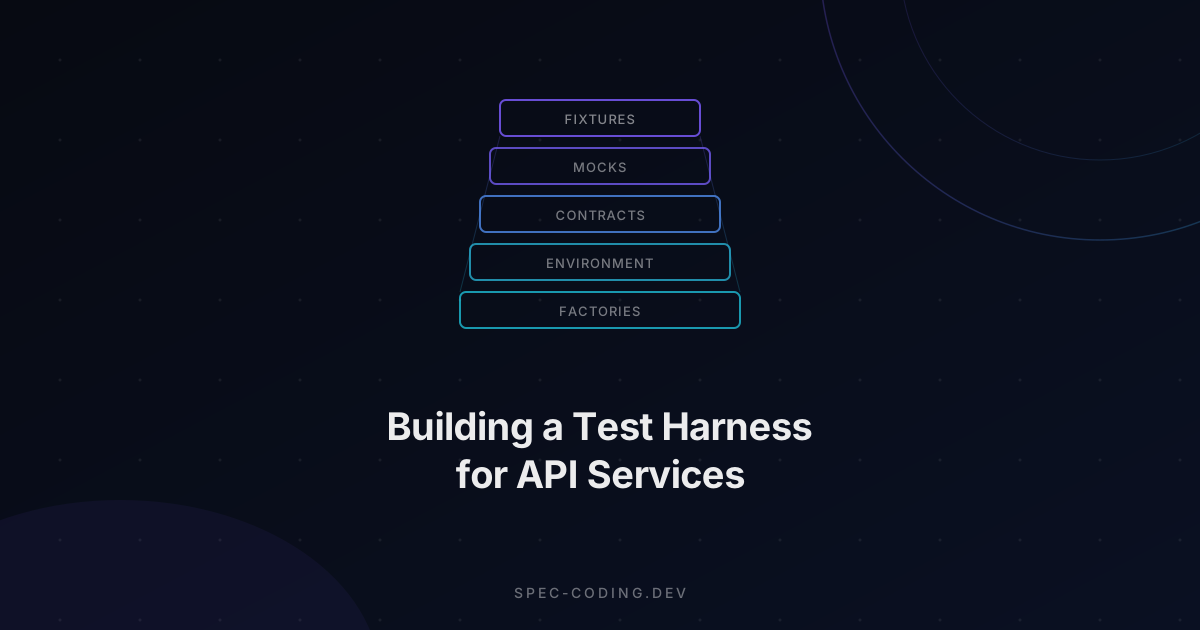
Harness engineering and spec-driven development solve adjacent problems. Spec-driven development defines the behavior before implementation starts. Harness engineering builds the deterministic test infrastructure that proves the behavior keeps working across pull requests, CI, and releases. This guide compares the two practices, then shows the five layers of a backend API test harness.
Quick Answers
- Spec-driven development defines correctness: goals, non-goals, API contracts, acceptance criteria, and evidence.
- Harness engineering proves correctness repeatedly: fixtures, factories, mocks, contract tests, and CI runners.
- Use both when a path is high-risk, touched often, or implemented by an AI coding agent that must show test evidence before review.
Why harness engineering is separate from spec-driven work
When a team says "we need to improve test coverage," the typical response is to write more tests. But the real bottleneck is rarely a shortage of test cases — it is the absence of the infrastructure that makes test cases reliable. A test that passes locally and fails in CI because the database was in a different state is not a flaky test. It is a test running without a harness.
A test harness is the layer between assertions and the system under test. It handles fixture loading, mock server lifecycle, database state management, environment bootstrapping, and test data generation. Without it, each test file reinvents this scaffolding independently. One test creates users by inserting raw SQL. Another calls the registration endpoint. A third imports a JSON fixture. All three break differently when the user schema changes.
This is why harness construction should be treated as a distinct engineering discipline — not as a side effect of writing tests. The deliverable is not a passing test suite. It is an infrastructure layer that makes every future test cheaper to write, faster to run, and more reliable in CI. Writing a single integration test takes an afternoon. Building the harness that makes that test deterministic across all environments takes a sprint.
Harness engineering vs spec-driven development
The difference is easiest to see in review. Spec-driven development decides what the code is supposed to do before the diff exists. It names the goal, non-goals, API contracts, edge cases, and release evidence. Harness engineering decides how that evidence will run repeatedly after the first implementation: which fixtures create state, which mocks replace external services, which contract tests guard interfaces, and which CI jobs block merge.
If the behavior is still ambiguous, start with the spec. If the behavior is agreed but every release needs the same manual checks, invest in the harness. If an AI coding agent is generating the implementation, use both: the spec constrains the agent, and the harness proves the output stayed inside the boundary.
| Practice | Main artifact | Failure if missing |
|---|---|---|
| Spec-driven development | feature.spec.md | Teams debate intended behavior during code review. |
| Harness engineering | fixtures, mocks, contract tests, CI runners | Teams know the behavior but cannot prove it cheaply. |
The five layers of a backend API test harness
A complete test harness for a backend API service has five distinct layers. Each one solves a specific category of testing problem, and each one has concrete tooling options that are well established in the ecosystem.
Layer 1: Fixtures
Fixtures are deterministic seed data that establish a known starting state for each test. Given the same fixture, the test produces the same result regardless of run order or prior database state. In pytest, fixtures are functions decorated with @pytest.fixture that yield setup data and handle teardown. The principle is universal — tests declare their preconditions, not assume them.
Layer 2: Data factories
Factories generate test objects programmatically with sensible defaults. A factory like factory_boy (Python) or fishery (TypeScript) lets each test declare only the fields it cares about: UserFactory.create(role="admin"). Every other field is filled automatically. This keeps setup concise and makes it obvious what each test verifies. When the schema gains a new required field, a single factory default fixes every test.
Layer 3: Mock servers
External dependencies — payment gateways, email providers, third-party APIs — should not be called during automated test runs. Mock servers stand in with predictable behavior. Prism generates a mock server directly from an OpenAPI spec, returning valid responses based on the schema's examples. WireMock provides more control over response sequences, latency simulation, and failure injection. The key requirement is that mock behavior stays synchronized with the real service's contract — a problem that contract testing exists to solve.
Layer 4: Contract test runner
Contract tests verify that the service's API behavior matches its published specification. Pact is consumer-driven: consumers publish expectations, and the provider verifies them. Schemathesis is spec-driven: it reads the OpenAPI document and generates test cases automatically, probing for schema violations and undocumented status codes. The choice depends on whether the primary concern is consumer compatibility (Pact) or spec compliance (Schemathesis). For teams already following a contract checklist, Schemathesis often provides faster time to first value because it requires no consumer-side test authoring.
Layer 5: Environment bootstrap
The bootstrapper brings a test environment from zero to ready: database migrations, service dependencies, configuration injection, feature flag defaults. Docker Compose is the standard tool — a single docker-compose.test.yml declares the service, its database, cache layer, and mock servers. Without it, tests depend on the engineer's local machine state, which is why they pass locally and fail in CI.
Five-layer harness architecture:

  ┌─────────────────────────────────────────┐
  │  Layer 5: Environment Bootstrap         │
  │  (Docker Compose, CI scripts)           │
  ├─────────────────────────────────────────┤
  │  Layer 4: Contract Test Runner          │
  │  (Pact, Schemathesis)                   │
  ├─────────────────────────────────────────┤
  │  Layer 3: Mock Servers                  │
  │  (Prism, WireMock)                      │
  ├─────────────────────────────────────────┤
  │  Layer 2: Data Factories                │
  │  (factory_boy, fishery, builder pattern)│
  ├─────────────────────────────────────────┤
  │  Layer 1: Fixtures                      │
  │  (pytest fixtures, setup/teardown hooks)│
  └─────────────────────────────────────────┘
Ordering by return on investment
Not every layer delivers the same value per unit of effort. Building from the bottom up maximizes the return at each step, because each layer depends on the ones below it.
Fixtures and data factories come first. They have the lowest cost (one to two days), the broadest impact (every test uses them), and no external dependencies. A factory that generates valid test objects in one line eliminates the single largest source of test friction: setup verbosity.
Mock servers come next. Two to three days of setup — generating stubs from the OpenAPI spec, configuring failure scenarios, wiring mocks into the test lifecycle — yields integration tests that run without network calls, making the suite both faster and deterministic.
Contract tests require the most design effort (three to five days) because they involve scope decisions: which endpoints first, consumer-driven vs. spec-driven, how to handle breaking change notifications. But they prevent the highest-cost failures — broken API contracts reaching consumers in production.
Environment bootstrap is a one-sprint investment that pays off in CI reliability and onboarding speed. It is built last because the team can function without it (with manual setup) while the other layers already deliver value.
| Layer | Effort | Impact | Build order |
|---|---|---|---|
| Fixtures + Data factories | 1-2 days | Every test is shorter, more readable, and more maintainable | First |
| Mock servers | 2-3 days | Integration tests run without network, 3-5x faster | Second |
| Contract test runner | 3-5 days | Breaking API changes caught before deployment | Third |
| Environment bootstrap | 1 sprint | CI parity with local, onboarding drops from days to hours | Fourth |
This ordering also means the team gets value after every step, not just at the end. After two days, tests are faster to write. After a week, integration tests run without external calls. After two weeks, contract violations are caught automatically. The harness does not need to be complete to be useful.
A one-sprint harness buildout timeline
The following timeline assumes a two-week sprint with one engineer dedicated to harness work. In practice, harness buildout can be split across two engineers, but the design decisions should be owned by one person to avoid inconsistency.
Week 1: Foundations
Day 1-2: Fixtures and factories. Define base factories for the service's core domain objects. Each factory produces a valid object with minimal arguments. Establish the fixture pattern: every test gets a clean database state via transaction rollback or schema isolation. Deliverable: one-line test object creation with automatic cleanup.
Day 3-4: Mock servers. Generate mock stubs from the OpenAPI specs of external dependencies. With Prism, this is a single command: prism mock openapi.yaml. Configure at least three failure modes per dependency: timeout, 500 error, and malformed response body. Wire mock lifecycle into the test framework. Deliverable: integration tests for the top two or three external dependency paths run entirely against local mocks.
Day 5: Integration and cleanup. Verify factories and mocks work together — a test that creates a user, triggers a payment via the mock, and asserts on the result should run in under two seconds. Fix any state leakage discovered during the full suite run. Write a short harness usage guide so the team can start using the infrastructure in week two.
Week 2: Contracts and CI
Day 6-7: Contract test suite. Choose the approach based on the service's role. Provider consumed by multiple clients: start with Schemathesis. Service consumes upstream APIs: start with Pact consumer tests for the two most critical dependencies. Cover the top ten endpoints by traffic or business criticality. Deliverable: a contract test suite that catches schema violations and undocumented response codes.
Day 8-9: CI integration. Add the full harness to the CI pipeline. Docker Compose brings up the service, database, and mock servers in one command. Contract tests run as a separate CI stage that blocks merge on failure. Split the suite into parallel shards by module to keep total CI time under ten minutes. Deliverable: every pull request runs unit, integration, and contract tests in CI.
Day 10: Documentation and handoff. Update the usage guide with contract test examples. Run a thirty-minute walkthrough: how to add a factory, a mock, a contract test. Deliverable: shared ownership — the harness is no longer single-engineer knowledge.
| Day | Focus | Deliverable |
|---|---|---|
| 1-2 | Fixtures + factories | One-line test object creation, automatic cleanup |
| 3-4 | Mock servers | Local mocks for top 2-3 external dependencies |
| 5 | Integration pass | End-to-end flow tests under 2 seconds each |
| 6-7 | Contract tests | Top 10 endpoints covered by schema or consumer contracts |
| 8-9 | CI pipeline | Full suite in CI, contract failures block merge |
| 10 | Docs + handoff | Usage guide, team walkthrough, shared ownership |
Common harness failures and how to prevent them
Even well-built harnesses degrade over time without deliberate maintenance. Four failure patterns appear repeatedly across teams and codebases.
Fixture bloat
The symptom: fixture files grow to hundreds or thousands of lines. Each test adds a few more records to the shared fixture set. Eventually, nobody knows which fixture records belong to which tests, and removing any record risks breaking an unknown test. The root cause is static fixtures — JSON or SQL files that accumulate over time. The solution is the factory pattern. Factories generate data per test, so there is no shared fixture file to bloat. Each test declares exactly the data it needs and nothing more. When the schema changes, the factory's defaults change in one place.
Mock drift
The symptom: tests pass against mocks, but the same request fails against the real service. This happens when mocks are hand-written and never updated to match upstream changes. Two approaches prevent it. Record-replay (VCR, Polly.JS) captures real responses and replays them in tests. Contract synchronization generates the mock from the same OpenAPI spec the provider validates against. Both tie the mock to reality. Hand-written mocks without either mechanism will drift within a quarter.
CI timeout spiral
The symptom: the CI test run takes thirty minutes, then forty-five, then an hour. Engineers stop waiting for it and merge without green checks. The root cause is usually sequential test execution with no parallelization and no selective test runs. The solution has two parts. First, shard the test suite into parallel groups by module or directory — most CI platforms (GitHub Actions, GitLab CI, CircleCI) support this natively. Second, implement selective test runs: only run tests affected by the changed files, using dependency analysis or file-path-based matching. A well-sharded suite of 2,000 tests should complete in under ten minutes on four parallel runners.
Shared database state
The symptom: tests pass in isolation and fail when run together. The root cause is tests writing to a shared database without cleanup. Transaction rollback wraps each test in a transaction and rolls it back after completion — the database never changes between tests. Per-test schemas create an isolated schema for each run, providing true isolation at the cost of higher setup time. For most services, transaction rollback is sufficient. Per-test schemas fit when behavior depends on DDL operations or the ORM lacks nested transaction support.
Failure pattern → Root cause → Solution:

  Fixture bloat      → static seed files     → factory pattern (per-test generation)
  Mock drift         → hand-written mocks     → record-replay or contract sync
  CI timeout spiral  → sequential execution   → parallel shards + selective runs
  Shared DB state    → no test isolation      → per-test transactions or schemas
When the harness investment pays for itself
A one-sprint harness investment does not pay for itself in the sprint it is built. The return shows up in the second and third sprints, and it compounds from there.
The first measurable change is regression cycle time. Before the harness, a typical service requires thirty to sixty minutes of manual QA per feature. After the harness, the same verification runs in CI in under ten minutes, on every commit. Over a sprint with fifteen to twenty pull requests, that difference adds up to multiple engineer-days recovered.
The second change is deploy confidence. When contract tests catch breaking changes before merge, the team stops discovering API incompatibilities in staging. The deploy process shifts from "merge and hope" to "merge and know," because the harness has already verified the critical paths.
The third change is onboarding speed. Without a harness, a new engineer spends one to three days setting up the local test environment. With Docker Compose and documented factories, the path is: clone, run docker-compose up, run make test. First green suite in under an hour.
The compound effect matters most. Each test written after the harness exists is cheaper than the one before it. The factory handles object creation, the mock layer handles dependencies, the CI pipeline handles execution. The engineer only thinks about the assertion — the part that verifies behavior. Over six months, a team with a mature harness writes tests at roughly three times the rate of a team without one. The harness is not overhead. It is leverage.
For teams already practicing spec-driven design for workflows, the harness provides the verification infrastructure that turns acceptance criteria into executable tests. The spec says what should happen. The harness makes it possible to check that it did.
Topic Path
This article belongs to the API Contracts track. Start with the hub, then use the checklist, template, or tool below on a real project.
Keep reading
Fill a form, get a complete feature spec in Markdown — free, no signup.
Editorial note
This article covers Building a Test Harness for API Services for backend engineering teams. Examples are illustrative engineering scenarios, not legal, tax, or investment advice.
- Author details: Daniel Marsh
- Editorial policy: How we review and update articles
- Corrections: Contact the editor
Consolidated Coverage
This canonical guide now covers several related notes that used to live as separate pages. Keeping them together makes Building a Test Harness for API Services easier to review, link, and use as the main reference.
- Connecting Specs to Test Harnesses: A Practical Workflow
- Harness Engineering vs Spec-Driven Development: What's the Difference?